

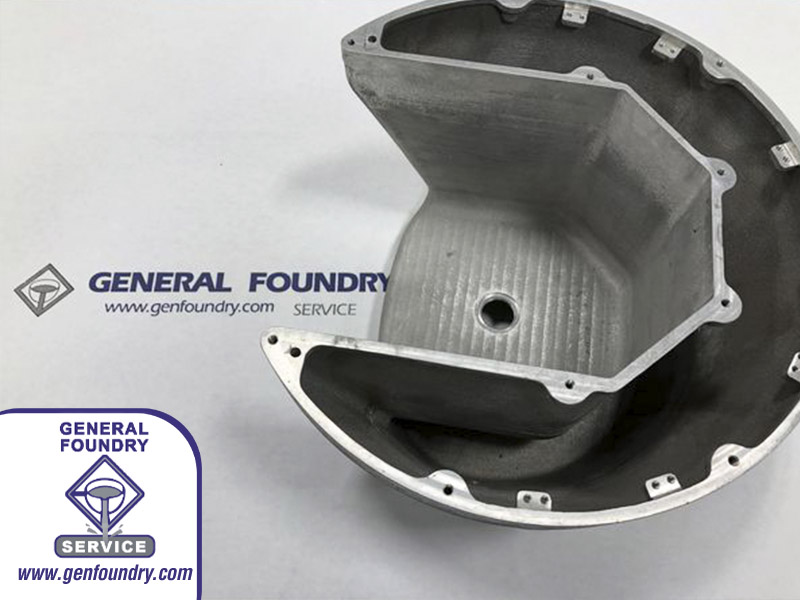
For decades, foundries and casting engineers have been constrained by the physical and economic limits of traditional sand molding. Tooling lead times, pattern storage, limited design flexibility, and the high cost of short-run or prototype castings have long presented significant pain points for customers requiring complex parts or rapid product development. These challenges are especially acute in industries such as aerospace, energy, and defense, where mission-critical components often demand short timelines, highly complex geometries, and minimal margin for error.
3D printed sand molding eliminates many of these obstacles by removing the dependency on conventional tooling and pattern fabrication. Customers no longer need to invest time and capital into expensive wood or metal patterns that must be carefully maintained and stored. Instead, a digital CAD file can be translated directly into a sand mold, reducing lead times from weeks or months to mere days. This shift provides tremendous value for customers who need to iterate designs quickly, meet tight production schedules, or respond to urgent, low-volume orders.
Beyond speed and cost savings, the design freedom offered by additive sand molding redefines what is possible in casting. Complex internal channels, lattice structures, and undercuts that were once impractical or outright impossible can now be easily achieved. For customers, this means better-performing components and greater efficiency in fluid flow, heat transfer, and overall system integration. Design optimization is no longer dictated by tooling limitations but by what delivers the best possible part performance.
Quality and consistency are also enhanced. Since 3D printed molds are created layer by layer under controlled conditions, dimensional accuracy is improved and variability between molds is reduced. This gives customers greater confidence in the repeatability and integrity of each casting, particularly for critical parts with tight tolerances. In industries where reliability and traceability are non-negotiable, this capability is transformative.
3D printed sand molding is not simply a technological evolution but a strategic advantage. Customers who embrace this process can reduce development cycles, accelerate time-to-market, improve component performance, and lower total cost of ownership. It empowers engineers to design for function rather than fabrication, allowing procurement and production teams to operate with greater agility and responsiveness.
How can General Foundry Service help you?
With over 80 years of casting experience in various critical industries, General Foundry provides you with “get it right the first time” quality and a genuine customer-focused approach to each project. We offer best-in-class turnkey solutions with multiple processes and alloy options to meet your component casting needs. Contact us today for more information or to get started on your next project.