

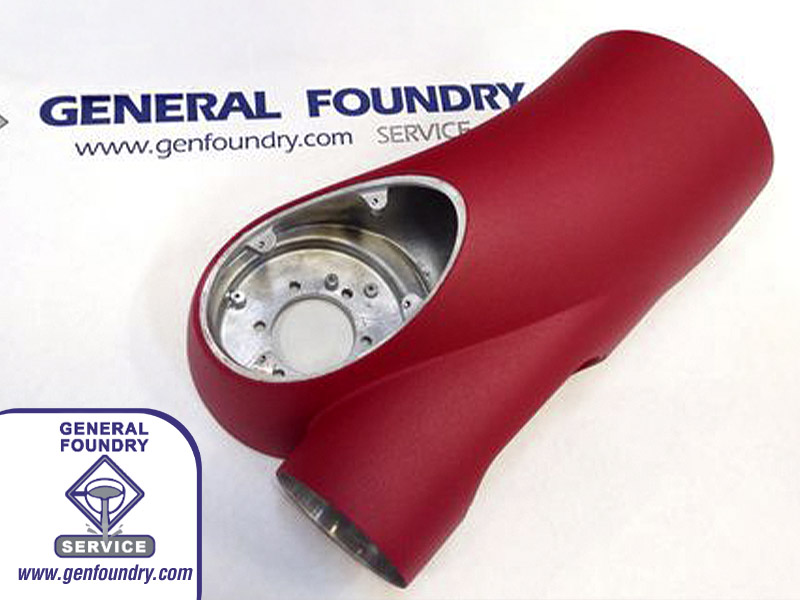
Rubber Plaster Mold Casting (RPM) is a highly effective process for producing low-volume precision aluminum and zinc alloy parts. It is particularly well-suited for engineers developing prototypes, bridge tooling, or short-run production components that require tight tolerances and complex geometry without the long lead times or high costs of permanent tooling. At our foundry, we use RPM to help customers reduce development cycles, validate designs, and deliver reliable performance with repeatability and compliance. Here, we outline the critical factors engineers must understand to fully leverage this process’s advantages.
1.) Master Pattern Quality Directly Impacts Mold Accuracy
In RPM, the first mold cavity is created by pouring liquid rubber over a master pattern – typically a CNC-machined, additive manufactured, or other high-resolution model. The precision of this initial pattern determines the dimensional fidelity and surface finish of all subsequent castings. Our team frequently works with engineers to verify pattern tolerances and recommend the most appropriate master fabrication method based on part complexity and functional requirements. For parts requiring micro-scale detail or engineering-grade accuracy, we may suggest specific additive manufacturing materials or finishing protocols to optimize the pattern prior to rubber molding.
2.) Rapid Turnaround Without Compromising Precision
Rubber plaster molds can be produced in a matter of days, not weeks, enabling significantly shorter development cycles compared to traditional metal tooling. However, this speed does not come at the expense of quality. We employ strict process controls in rubber mold preparation, slurry composition, and curing to maintain dimensional accuracy and surface finish. This allows engineers to iterate designs quickly without sacrificing performance, making RPM ideal for applications where design evolution is still ongoing or where a fast path to functional parts is critical.
3.) Fine Surface Finish and Thin Walls Are Inherent Advantages
Rubber Plaster Mold Casting can produce castings with surface finishes approaching 63–125 µin (1.6–3.2 µm) Ra, and wall thicknesses as low as 0.040–0.080 inches (1–2 mm), depending on alloy and geometry. RPM offers a superior alternative to traditional sand casting or machining from billet for applications in medical devices, instrumentation, and aerospace housings, where cosmetic appearance and tight envelopes are essential. In many cases, parts produced through RPM can go directly to assembly with minimal or no post-processing.
4.) Complex Geometries with Undercuts, Thin Features, and Insert Integration
The flexibility of the initial rubber mold enables us to cast complex features that are either costly or impossible with conventional tooling. This includes fine ribs, enclosed channels, bosses, and undercuts. In addition, inserts such as helicoils, pins, or bushings can be integrated into the casting during the pour, allowing the engineer to reduce part count and downstream operations. This capability is frequently leveraged in prototype or pilot-production builds where functional testing must mirror full-scale production assemblies.
5.) Consistent Mechanical Properties Through Process Control
Although RPM is a low-volume process, our approach emphasizes consistency and traceability. By controlling mold preheat, alloy temperature, venting, and pour rate, we achieve repeatable microstructures and mechanical properties that meet or exceed engineering specifications. We routinely cast aerospace-grade aluminum alloys and zinc-aluminum alloys, and validate key metrics such as yield strength, elongation, and density through destructive and non-destructive testing.
6.) Traceability and Compliance for Regulated Industries
Despite its reputation as a prototyping method, RPM can fully comply with regulated industries’ quality and documentation requirements. We maintain traceability of all materials, batch records, and inspection data. Castings can be certified to AMS, ASTM, MIL, or customer-defined specifications, as required. This makes RPM an excellent choice for pre-production validation parts, first-article testing, or low-rate initial production (LRIP) programs in aerospace, defense, medical sectors, and others.
7.) Total Cost Advantage in Early-Stage and Niche Production
The total cost benefit of RPM lies in its ability to eliminate expensive hard tooling while maintaining a high degree of functional and cosmetic fidelity. For prototype builds, design validation, or production runs <2,000 units, RPM typically outperforms both CNC machining and investment casting in cost, lead time, and design flexibility. Customers who adopt RPM early in their product lifecycle often realize faster time-to-market, fewer design revisions, and significantly lower development costs without compromising final part quality.
Rubber Plaster Mold Casting is not merely a substitute for traditional casting methods – it is a strategic tool for design agility, performance validation, and low-risk production. Engaging with the foundry at the early stages of the design process allows us to align pattern development, material selection, and casting parameters with your performance objectives. Our engineering team is available to assist with design reviews, material selection, and process planning to ensure that every RPM casting meets your exact requirements for function, finish, and compliance.
How can General Foundry Service help you?
With over 80 years of casting experience in various critical industries, General Foundry provides you with “get it right the first time” quality and a customer-focused approach to each project. We offer best-in-class turnkey solutions with multiple processes and alloy options to meet your component needs. Contact us today for more information or to get started on your next project.