

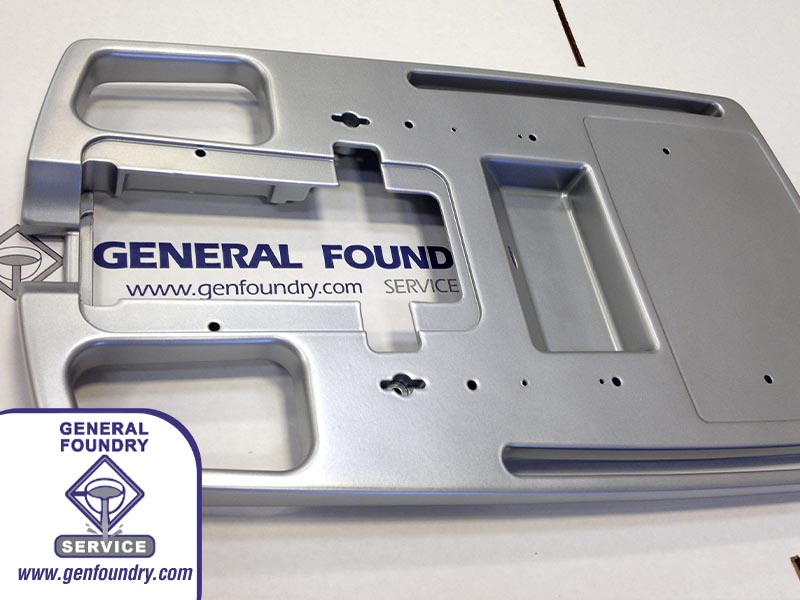
The balance between surface finish quality and tooling cost in metal casting is a core consideration in early-stage design and prototyping. For critical engineering applications – particularly in aerospace, defense, medical, and instrumentation – rough surface profiles can impact sealing interfaces, fluid dynamics, fatigue initiation sites, and secondary machining requirements.
General Foundry Service addresses this balance by offering a diverse portfolio of five distinct aluminum and zinc-aluminum casting processes, each optimized for different surface fidelity, part complexity, and cost structure. This article provides an engineering deep dive into how each process contributes to resolving surface finish challenges, without exceeding tooling budget constraints.
General Foundry offers multiple metal casting processes, including:
- Green Sand Casting
- No-Bake (Air-Set) Sand Casting
- Rubber Plaster Mold (RPM)
- Investment (Lost Wax) Casting
- Permanent Mold
- 3D-Printed Sand Mold Casting
Each of these has a distinct surface finish profile and associated tooling cost.
| Process | Typical Surface Finish (µin Ra) | Tooling Cost | Notes |
| Green Sand Casting | 125-175 | Very Low | Fast and economical; rougher finish; suitable for low-precision parts. |
| No-Bake (Air-Set) Sand Casting | 200-400 | Low | Better surface than green sand; good for larger, complex geometries. |
| RPM (Rubber Plaster Mold) Casting | 80-120 | Moderate | High detail; ideal for thin-walled parts and short-run production. |
| Investment (Lost Wax) Casting | 65-90 | Moderate | Excellent feature detail and dimensional control; suitable for complex parts. |
| Permanent Mold | 200-400 | High | Best for repeatability and finish in higher volumes; limited complexity. |
| 3D-Printed Sand Mold Casting | 200–400 (improving with resin tech) | No Tooling | Great for complex or one-off parts; finish improving with fine-resolution printers. |
1.) Surface Finish Root Cause Analysis – Process-Originated Defects
Achieving a smooth surface finish begins with understanding process-driven roughness contributors, such as:
- Molding media grain size and uniformity.
- Pattern fidelity and degradation over time.
- Gas porosity and entrainment.
- Thermal shock and metal/mold reaction.
- Surface turbulence and oxide formation.
Each casting process addresses these mechanisms with varying efficacy. For instance, RPM and Investment Casting produce better surfaces due to tighter control over mold wall integrity and material flow, whereas Green Sand inherently carries higher variability due to loose-packed sand and moisture sensitivity.
2.) Pattern & Tooling Strategy – High Fidelity, Low Cost
To mitigate surface finish issues, General Foundry emphasizes pattern optimization at the front-end, especially in low-cost tooling environments:
- RPM: Utilize high-resolution CNC machined patterns enabling sub-50 µm feature fidelity.
- Investment: CNC machined aluminum molds to inject wax to produce wax patterns, enabling sub-50 µm feature fidelity and minimizing micro-ripple transference. 3D printed wax patterns can be produced for prototype quantities. The surface finish of these patterns will be similar to a 3D printed part with build layering or “stair-stepping”.
- No-Bake and Green Sand: Require precision matchplates or loose patterns. Even small misalignments or poor wood/urethane tooling finish can telegraph into the casting.
- 3D Printed Sand Molds: Bypass tooling entirely; focus shifts to the resolution of the binder jetting or binder resin dispersion—optimal results with layer thickness ≤ 100 µm.
Tooling design must incorporate proper draft, fillet radii, and surface texture definitions, directly affecting mold release and final surface quality.
3.) Mold-Media Control & Pour Parameters
Mold quality and metal handling are directly tied to surface finish outcomes. Key process controls employed by General Foundry include:
- Green Sand: Use of controlled sand grain distribution, moisture content, and compaction pressure. Additives like seacoal improve mold face resilience and surface definition.
- No-Bake: Resin-coated sands offer better surface hardness and smoother imprinting. Curing kinetics and venting strategy are critical to avoid veining and burn-on.
- RPM: Plaster is poured under atmospheric control; this reduces micro-voids and surface pinholing.
- Investment Casting: Dip-slurry shell systems are built up in a cleanroom-like environment, minimizing inclusions and ensuring uniform shell thickness. For solid mold plaster systems, a plaster/water matrix system is used. Dewaxing schedules are tightly controlled to avoid shell microfractures.
- Permanent Mold: Preheating molds and consistent mold coatings (boron nitride or graphite-based) help manage solidification rates and metal/mold reactions, minimizing chill lines and surface peel.
- 3D Printed Sand: Post-processing the printed molds (e.g., furan resin curing and sand densification) is critical to reduce surface powdering and improve surface cohesion.
Controlled pour temperature, mold temperature, and fill velocity are standardized and validated per alloy family to prevent oxidation artifacts and cold shuts.
4.) Strategic Use of Post-Cast Surface Conditioning
While the goal is to minimize post-processing, General Foundry employs scalable finishing strategies:
- Media Blasting: Aluminum oxide, ceramic bead or glass bead finishing for matte uniformity without dimensional loss.
- Abrasive Flow or Tumbling: Used on all components for internal and external smoothing.
- Precision Handwork: Applied selectively in cosmetic zones for prototypes or customer-visible components.
- CNC Machining (Hybrid Approach): Employed when specific surfaces require ≤32 µin Ra or tight tolerance flatness perpendicular to cosmetic faces.
These are introduced selectively, based on engineering tolerance stacks and cost-benefit analysis.
5.) Iterative DFM Collaboration & Design Tuning
Process-driven surface improvement is not isolated to the foundry; design for manufacturability (DFM) engagement is crucial. General Foundry’s engineering team supports:
- Geometry adjustments (chamfers, transitions, flow optimization).
- Localized finish zoning (prioritizing critical areas).
- Rapid iteration cycles using RPM or 3D printed sand molds, enabling fast revalidation without full tool recuts.
This loop drastically accelerates design maturity to castability, especially for high-complexity, cosmetic-intensive parts.
Process Discipline Enables Finish Without Tooling Inflation
Engineers are frequently asked to reconcile budget constraints with demanding surface specifications. General Foundry Service’s process-centric model allows for data-driven casting selection, ensuring surface finish targets are met without excessive tooling investment.
The key to solving surface finish issues at low tooling cost lies not in brute-force polishing or over-spec’d tooling, but in selecting the proper casting process, controlling input variables, and collaborating early on pattern and part design.
How can General Foundry Service help you?
With nearly 80 years of casting experience in various critical industries, General Foundry provides you with “get it right the first time” quality and a genuinely customer-focused approach to each project. We offer best-in-class turnkey solutions with multiple processes and alloy options to meet your component casting needs. Contact us today for more information or to get started on your next project.