

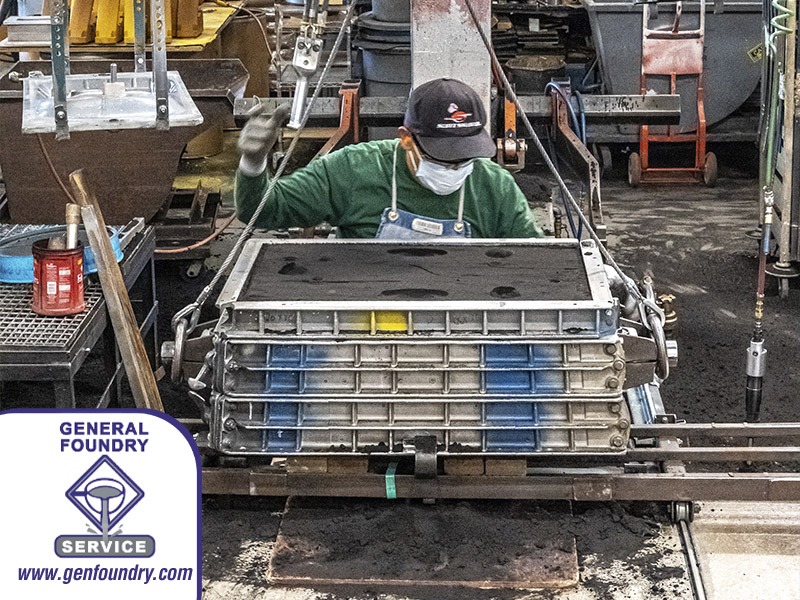
Scaling a sand casting from 5 lbs. to 150+ lbs. is not a linear progression. In aluminum and zinc aluminum sand cast components, increased thermal mass alters how the metal solidifies, how the casting moves during cooling, and how dimensions stabilize over time. Small design decisions that seem insignificant in a compact part can create amplified challenges in a large-format casting.
At General Foundry Service, we work with engineers developing large aluminum and zinc aluminum sand castings across a range of industries. Many of the production challenges we see are not caused by the process itself – they originate in early design assumptions. Below are critical areas to evaluate before tooling is built and metal is poured.
1.) Thermal gradients and section transitions
In sand casting, cooling rate drives microstructure and soundness. Large castings intensify the difference between thick and thin sections. Heavy areas retain heat significantly longer, while thinner walls solidify quickly. When these regions are directly connected, the risks increase:
- Shrink porosity
- Hot tearing
- Residual stress
- Post-cast distortion
Abrupt transitions, such as thick mounting bosses directly attached to thin walls, are especially prone to solidification imbalance.
Design guidance: Favor gradual transitions in wall thickness. Use ribbing to increase stiffness rather than adding bulk mass. When heavy sections are required, anticipate how feeding and directional solidification will be managed within the sand mold environment.
2.) Feeding strategy and internal soundness
Large aluminum and zinc aluminum castings require a deliberate feeding strategy. As the section size increases, the difficulty of delivering molten metal to shrinking regions during solidification increases. A common late-stage revision – “add more material for strength” – can unintentionally create isolated mass that cannot be fed properly with the original gating and riser plan.
Design guidance: Structural changes should be evaluated alongside solidification behavior. Early collaboration with your foundry allows the feeding strategy to evolve with the design rather than reacting after tooling is committed.
3.) Flatness and dimensional stability across long spans
Sand cast aluminum components with wide envelopes are susceptible to cumulative dimensional changes. Even minor shrinkage variation becomes measurable over extended distances. Large flat surfaces are susceptible to:
- Warpage during cooling
- Movement during stress relief
- Distortion during machining
Design guidance: Incorporate ribs or structural features to stabilize large panels. Evaluate flatness requirements in the context of the overall casting size. Develop the machining and datum strategy in parallel with casting design to manage tolerance stack-up effectively.
4.) Machining allowance and datum strategy
Large castings often require significant machining. However, improper stock allowance can introduce new risks:
- Breaking into subsurface porosity
- Exposing surface variation
- Creating unstable datum relationships
Excessive machining stock, on the other hand, increases cost and cycle time.
Design guidance: Establish primary datums early in the design process. Ensure adequate machining stock in areas subject to shrink variation, particularly near heavy sections. Casting and machining considerations should be integrated – not sequential decisions.
5.) Handling, fixturing, and structural behavior during processing
Large castings introduce practical realities that smaller components rarely face:
- How will the casting be safely lifted?
- Where will it be supported during machining?
- Will it deflect under its own weight?
Deflection during processing can influence both safety and dimensional accuracy.
Design guidance: Design intentional lift points when necessary. Avoid relying on thin sections as incidental support surfaces. Consider fixturing and clamping access during CAD development rather than after the fact.
6.) Surface finish expectations in sand castings
Surface variation becomes more visible as part size increases. Large exposed surfaces can highlight even minor inconsistencies inherent to sand casting. This is particularly important when:
- The component is visible in end-use applications
- Secondary coatings require consistent substrates
- Cosmetic blending is limited
Design guidance: Differentiate clearly between functional and cosmetic surfaces. Align finish expectations with sand casting capabilities early to avoid unnecessary post-processing or cost escalation.
7.) Tolerance stack-up across large envelopes
Tolerance accumulation behaves differently across long geometries. A ±0.010” variation across 4” is not equivalent to the same tolerance across 48”. Hole-to-hole positional tolerances, alignment of mounting interfaces, and dimensional relationships across wide spans can become challenging to control without a deliberate datum strategy.
Design guidance: Whenever possible, tie critical features to machined datums rather than relying on as-cast surfaces. Review whether tight tolerances are functionally required or inherited from legacy specifications.
8.) Mechanical properties and cooling rate effects
In large sand castings, heavier sections cool more slowly. Cooling rate influences microstructure, which directly affects:
- Tensile strength
- Ductility
- Fatigue resistance
Assuming that properties derived from small test bars will translate identically to thick casting sections can create performance gaps.
Design guidance: Select aluminum and zinc aluminum alloys based on actual section thickness and loading conditions. Align the heat treatment strategy with realistic cooling behavior. Validate property expectations against the casting’s true geometry – not idealized samples.
The Core Principle: Design for sand casting physics
Large aluminum and zinc aluminum sand castings succeed when geometry, metallurgy, feeding strategy, machining, and inspection are aligned from the outset. Most issues (porosity exposure, distortion, tolerance instability, cosmetic concerns) are not random defects. They are predictable interactions between design and process physics. Early collaboration between engineering and foundry teams reduces redesign cycles, shortens tooling iteration, and improves long-term production stability. The objective is not simply to make a large casting manufacturable. It is to make it dimensionally stable, structurally sound, and repeatable across the life of the program.
How can General Foundry Service help you?
With over 80 years of casting experience in various critical industries, General Foundry provides you with “get it right the first time” quality and a genuine customer-focused approach to each project. We offer best-in-class turnkey solutions with multiple processes and alloy options to meet your component needs. Contact us today for more information or to get started on your next project.