

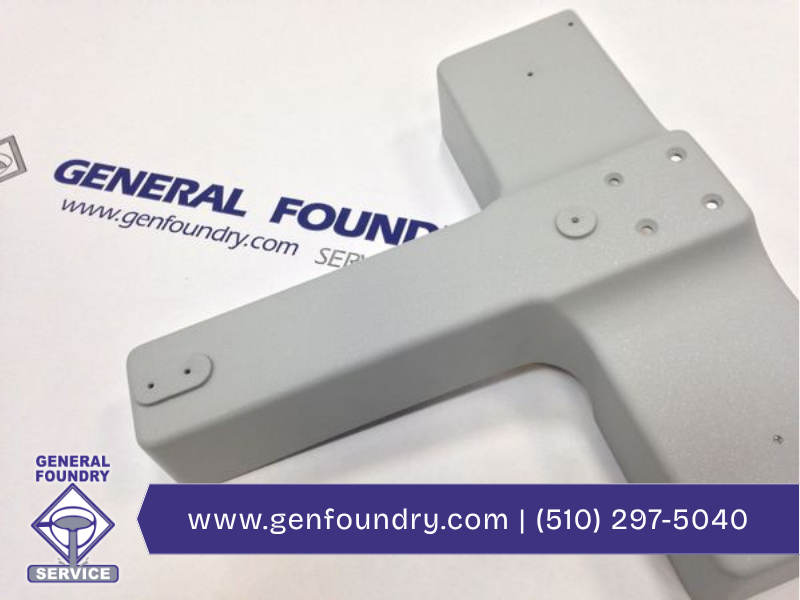
The use of zinc-aluminum (ZA) alloys in cosmetic medical device base castings depends heavily on tooling quality – especially patterns, core boxes, cores, and mold features that govern fill, venting, and shrinkage. In General Foundry Service’s sand casting processes, achieving consistent cosmetic appearance and reliable internal geometry starts with defect-resistant tooling that can reproduce surfaces and core locations repeatably from one run to the next. With disciplined tooling design, the casting “behavior” becomes predictable, reducing the need for heavy finishing and helping keep cosmetic zones within acceptance.
Alloy Selection and Advantages
Zinc-aluminum alloys such as ZA-8 (8% aluminum) are attractive when cosmetic medical device bases require good dimensional stability and a surface that can be finished without excessive removal. Even though the alloy’s castability matters, in sand casting the tooling system often determines whether the surface remains uniform and whether internal features stay aligned. ZA alloys can provide the balance of fluidity and precision needed for exposed components when the pattern and mold architecture are engineered to support consistent filling, feeding, and shrink control.
Tooling and Mold Design Considerations (Patterns, Coreboxes, Cores, Mold Features)
Optimized tooling is the first step to consistent cosmetic and mechanical performance in ZA castings. The pattern directly controls surface fidelity: draft and surface texture on all cosmetic faces influence how the casting releases from the mold and how much corrective finishing will be required. Include consistent draft (commonly 1°–3° per side on withdrawable cosmetic surfaces) and radii at transitions to reduce handling damage and help promote smooth metal flow across the cavity. Design for uniform wall thickness where possible to avoid localized shrinkage and defect “hot spots” that can appear in flat or highly visible regions.
Coreboxes and core assembly are equally critical because internal geometry and core seating affect both dimensional accuracy and surface quality around core interfaces. Use coreboxes that produce stable, repeatable cores with sufficient strength to resist movement during mold fill and shakeout. Ensure reliable core positioning through robust prints and locating features so internal passages, bores, and pockets remain concentric and correctly located. Venting must be addressed at the core and mold levels: trapped gases against core surfaces can lead to surface-connected porosity or burn-on-like defects that are difficult to remove without altering critical dimensions.
Gating, runner, and mold fill behavior are controlled by mold assembly tooling and directly influence cosmetic outcomes. Use gate/runner geometry that minimizes turbulence to reduce oxide entrainment, surface disruption, and the likelihood of cold shuts. Provide appropriate vents and overflows where needed to allow gases to escape and to manage metal flow consistently during filling. Runner and gate sizing should support smooth velocity control so the mold fills evenly, improving soundness in the body of the part and reducing defects that would otherwise require abrasive or aggressive finishing to correct.
Post-Casting Finishing and Quality Assurance
Sand-cast ZA (zinc–aluminum) parts often require less post-casting machining than many ferrous castings. However, cosmetic medical-grade components still require controlled finishing to maintain surface uniformity and dimensional compliance. Focus on removing flash and surface irregularities without degrading critical cosmetic faces. Light mechanical deburring and targeted finishing (such as vibratory processing with carefully selected media or controlled abrasive methods) are commonly used when flash must be reduced while keeping tight tolerance features intact. When surface texture and uniformity are part of the cosmetic requirement, treat the finishing process as part of the tooling-to-finish system, not an afterthought.
Quality assurance should be structured around both appearance and internal soundness. Combine high-sensitivity visual inspection (raking light and magnification) with nondestructive testing where it affects acceptance, such as dye penetrant testing for surface-breaking defects and X-ray/CT for internal porosity or signs of core-related issues. Use functional vs cosmetic zoning so acceptance thresholds reflect how a defect affects performance or presentation, and ensure inspection is consistent across batches so trends can be traced back to tooling or process deviations.
Implement process control that ties results back to the tooling and molding inputs that drive defect formation. Maintain traceable batch and run records that include the variables most closely linked to sand/plaster outcomes: pouring and solidification conditions, finishing cycle timing, coating thickness (if applied), and any tooling condition indicators, such as wear intervals for patterns and corebox components. SPC on critical characteristics can highlight drift early, and linking out-of-spec results to likely causes (such as core seating changes, venting performance, or mold assembly variation) reduces rework and speeds corrective action.
A Few Quick Tips for Better Parts:
- Collaborate early with your foundry to avoid design features that are difficult or expensive to cast in sand/plaster, especially in cosmetic zones.
- Use generous radii on corners and transitions, and keep parting-line decisions in mind so release and flow don’t create cosmetic risk areas.
- Design and maintain coreboxes for repeatability; unstable cores or inconsistent seating are common causes of dimensional drift and surface-related defects.
- Ensure vents where gases accumulate – particularly around core surfaces and deep pockets – to reduce porosity that becomes visible after finishing.
- Keep gating/runner/tooling geometry focused on smooth fill to reduce turbulence-related surface defects and internal quality issues.
ZA zinc-aluminum castings deliver a cost-effective, high-fidelity platform for cosmetic medical device bases when the tooling system – patterns, coreboxes, cores, gating, venting, and mold assembly – supports consistent fill and shrink control. With disciplined tooling design and finishing backed by targeted NDT and tooling-aware SPC, you can produce parts that meet strict dimensional and cosmetic requirements while minimizing rework and time-to-market.
How can General Foundry Service help you?
With over 80 years of casting experience across various critical industries, General Foundry delivers “get it right the first time” quality and a genuine customer-focused approach to every project. We offer best-in-class turnkey solutions with multiple processes and alloy options to meet your component needs. Contact us today for more information or to get started on your next project.